Minggu, 10 Maret 2013

Why I aint selling my fuel guzzler

Roy Maugeri is my new hero.
Roy Maugeri, oil pundit who predicts
an oversupply in seven short years.
One of the world's foremost experts on oil, gas, and energy, he released a study showing that oil is NOT running out... haikona bru: its getting more.
Maugeri's latest paper show worldwide discoveries of new oil and gas supplies are at such an unprecedented level that the latest predictions have supply outpacing consumption by 2020. More on him here.
Would this lead to a drop in oil prices as he predicts?
Nope.
It costs more to get the oil out of the new fields, the new wave of Chinese and Indian motorists all wants to burn the stuff, and besides, oil producers have a fine tradition to uphold when it comes to charging top dollar - using any excuse and exploitative law under the sun.
In short, they still have us over a barrel.
But it may slow down the spiraling increases we have glumly been accepting as a fact of life because the oil-peakers said it was so since the mid 2000s.
A bit.
Based on Maugeri field-by-field analysis of most oil exploration and development projects in the world, his paper suggests that an unrestricted, additional production (the level of production targeted by each single project, according to its schedule, unadjusted for risk) of more than 49 million barrels per day of oil (crude oil and natural gas liquids, or NGLs) is targeted for 2020, the equivalent of more than half the current world production capacity of 93 mbd.
After adjusting this substantial figure considering the risk factors affecting the actual accomplishment of the projects on a country-by-country basis, the additional production that could come by 2020 is about 29 mbd. Factoring in depletion rates of currently producing oilfields and their “reserve growth” (the estimated increases in crude oil, natural gas, and natural gas liquids that could be added to existing reserves through extension, revision, improved recovery efficiency, and the discovery of new pools or reservoirs), the net additional production capacity by 2020 could be 17.6 mbd, yielding a world oil production capacity of 110.6 mbd by that date – as shown in Figure 1. This would represent the most significant increase in any decade since the 1980s.
Read more here
So if we won't pay less, but just more less faster, why am I so happy? For  one, I don't have to sell my fuel-guzzling, genly-rusting slow-but-steady old Toyota Land Cruiser - a car that fits my ego like a metal glove. And two, the mendicant nomads on www.couchsurfing.org can still afford to fly all over this wondrous planet of ours.

Hard racing in rally opener


Champions Robin Houghton and Mark Cronje
defended their title in the first leg of the South African Rally.

SOUTH African rally champions Mark Cronje and Robin Houghton (S2000 Ford Racing Fiesta) dominated the season-opening Total Rally that took place on the South Coast on Friday and Saturday.
Thirty cars entered the first day of racing, which was marked by high drama and sportsmanship. In the worst crash of the race, Enzo Kuun and Guy Hodgson rolled their new Polo within sight of the finish on stage three while fighting for second place with Jan Habig and Robert Paisley in their Basil Read Fiesta. The multi-million-rand Sasol Racing Polo was severely damaged after rolling end over end several times, but Kuun and Hodgson were only bruised.
The crash set the tone for the rest of the rally, which saw Cronje and Houghton stop in the next stage to check on competitors Johnny Gemmel and Carolyn Swan. The pair ended up in the cane when they lost steering in their Toyota Yaris after hot gases from a broken exhaust pipe ignited a power steering pipe and caused their retirement on Friday. They restarted on Saturday under penalty time, but gave a demonstration of the new Toyota’s potential by finishing in the top three in four of the seven gravel stages and winning the final one.
Cronje and Houghton continued their good form on Saturday with six out of nine stage wins.
Former champions Habig and Paisley made it a 1-2 for Ford, finishing 65 seconds behind the winners after starting the final day 34 seconds in arrears. They won a stage on each day and were the only S2000 crew to keep the champions honest.
Third were the Team Total combination of Jean-Pierre Damseaux and new co-driver Hilton Auffray in the first of the S2000 Challenge cars in a Toyota Auris, who did well to overcome a strong challenge on Saturday from the Castrol Team Toyota Yaris of Leeroy Poulter and Elvene Coetzee.
The battle between the two Yaris crews was a feature of the event, with Poulter and Coetzee giving their new rally car an impressive debut, occupying third place throughout the day until they were slowed by power steering problems on the last two gravel special stages.
The Toyota pair picked up a 40-second penalty for lateness after repairing a broken power steering pulley and dropped to fourth behind Damseaux and Auffray with just the 1,3 kilometre tarmac super-special stage on the site of the old Durban drive-in remaining.
After tweeting that he would have to garner whatever points he could in a car that was just not gelling with him, Gugu Zulu nevertheless finished fifth overall with co-driver Carl Peskin.
They were the first of the factory Volkswagen Polos in after a disastrous weekend for the factory-based VW Sasol racing team.
After ending in a surprising third place overall on Friday night, the youngest driver in the rally, Henk Lategan (18), and veteran Barry White clipped a concrete tunnel wall and ended up setting fire to the cane. The flames saw the cancellation of stage eight, the first of Saturday’s six gravel stages, as officials and bystanders pitched in to extinguish the blaze caused by the car’s hot exhaust setting fire to the dry undergrowth.
Lategan followed Gemmel’s example with a spirited fight-back to win stage 12 on his way to 23rd overall and 13th among the S2000 vehicles.
Zulu and Peskin were challenged for fifth by Team Total Toyota’s Mohammed Moosa and Andre Vermeulen in their Auris.
Racing hard, Moosa also clipped a bridge and later put his Auris on its roof after hitting a drainage ditch. In true rally tradition, Moosa and Vermeulen rolled the light car back on its wheels and finished eighth overall and fourth in the S2000 Challenge.
Rounding out the top six and missing a top-five finish by five seconds were Giniel de Villiers and new co-driver Greg Godrich in their S2000 Imperial Toyota Auris. De Villiers caught a 40-second penalty for lateness after replacing a power steering pump.
Former champions Hergen Fekken and Pierre Arries (VW Sasol racing) ­also competed under penalty time on Saturday after they went off the road on Friday’s first stage and were unable to continue.
They finished 18th overall and 11th in S2000, but the second fastest time they achieved in Saturday’s first two stages before they lost time with a puncture on stage 12 was a reminder of the VW Polo’s potential. — WR.
Photo:
Quickpic
National rally champions Mark Cronje and Robin Houghton raced with precision through the cane fields outside Scottburgh in their Ford Fiesta in the past weekend’s Total Rally. INSET: Houghton (left) and Cronje jubilant after holding off a hard-chasing field to defend their title in the first of eight races in the national rally season.

Jumat, 08 Maret 2013

Cane ploughing in KZN rally

Photo: Rajesh Jantilal
The UK’s Ashley Haigh-Smith and Craig Parry
in the crowd-pleasing Super Special Stage of
the Total Rally, held in Durban last night.
IN a rally full of drama and sportmanship yesterday, champion drivers Mark Cronje and Robin Houghton stopped to help Johnny Gemmel and Carolyn Swan, who had done some alarming cane harvesting using their Castrol Toyota Auris.
This just after Enzo Kuun and Guy Hodgson had rolled in their Sasol Polo in the third stage of the Total Rally, which started in Scottburgh and ended in Durban.
They crashed out of the event on stage three in spectacular fashion within site of the finish. The crew was dazed and the car is a write-off. Kuun was lying third at the time.
Morne Janse van Rensburg and Rickus Foure also “went surgarcane farming” in their Polo on the second corner of the stage, according to a tweet by Fourie.
The crashes show just how hard the other teams are racing to try and unseat Cronje and Houghton this year.
Luckily, none of the drivers who made unplanned safaris in the canefields were injured. The various crashes however saw stages 4 and 6 cancelled and of the thirty crews who departed to Durban yesterday, six did not start this morning.
Finishing a surprising third place yesterday was matriculant Henk Lategan. At 18, Lategan is the youngest driver yet in SA rallying. He is racing in Sasol VW car number 17 with veteran navigator Barry White.
In car nr 314, S20, privateers from Pietermaritzburg, Thane Archer and Frans de Wit, aim to have a blast with the big guns from out of town.
Yesterday’s racing culminated with a crowd-pleasing Super Special Stage, held on tar at the old Drive-Inn.
Today’s timed rally is 171 km long, returning to Scottburgh.
The 24 crews whose cars survived yesterday will contend not only with other racers under the influence of red mist, but KZN’s famously slippery and unpredictable dirt roads over 14 gravel stages back to Scottburgh.
The action ends by mid-afternoon today. More details on the stages and spectator maps at www.totalmotorsport.co.za.


Driving Africa's longest road train


The longest road trains in Africa are 42 metres and weigh 60 tons when empty.
A Western Star with Cummins ISX 565 linked to a 7-speed, 14-ratio
Allison auto box which gives non-stop power to the Isus axles,
pulls four side-tipper trailers designed by Afrit and Unitrans Mining.
As reported on sister blog TheDriverDigest, the longest road train in Africa operates at Richardsbay Minerals in KwaZulu-Natal, South Africa.
Operated 24/7 by Unitrans, these road trains are driven on average for 19 hours day by a relay team of four drivers per train.
Each train has a Western Star with a Cummins ISX 565 straight six pulling four Afrit wagons.
Empty the rig weighs 60 tons, which equates to one tone each for the 60 wheels at the back.
With so many wheels, drivers expected the rig to trammel like the devil himself, but a healthy dollop of  science and a little voodoo magic from the Afrit toolbox has ensured that each of the axles under the road trains tracks true.

The now "short" roadtrains still running at Richardsbay
Minerals in South Africa average 19-hour working days.

This means drivers no longer have to plan for a tail-whipping over-reaction on the last wagon after any  steering correction up front.
An Allison gearbox with 14 forward ratios ensure continuous power delivery to the three heavy-duty Sisu axles from Finland.
The elite group of drivers controlling these rigs say the true tracking and continuous power delivery makes  driving these 42,15 metre monsters "almost easy", compared to the older, tail-happy three axle road trains.
"Almost", for turning a 42 metre rig tomorrow requires from the driver to have started planning that turn last week. Once committed to a radius, no corrections can be made to the decreasing corners cut by the 30 rear axles.

Selasa, 05 Maret 2013

Chosing a cheap bakkie

Sister blog THE Driver Digest was recently asked what bakkie was a good buy if one could not afford an entry level Hilux of some R180 000.
After advising the asker on how to choose an engine for Newton metres to move a heavy load, or kilo-Watts to move light loads fast, we suggested three answers. 
Based on mileage and load, readers can pick the best course of action to find a budget bakkie or van that will meet their business needs.

Rent a bakkie 
For ad hoc jobs, just rent it. Commercial vehicles must earn their keep by carrying a payload, and if your need is to have one for a few days in a month, rent it rather than carry all that wear and tear.
There are many companies let out bakkies in South Africa for less than R400 a day excluding fuel and mileage after the first 200 km. But watch out for fly-by-nights who ALWAYS try to sting the renter
after the deal with damages that suddenly appeared. Avoid this unpleasentness by making a thorough inspection of the car before taking delivery.
For those lucky enough to live in KZN, Key Group have good deals  and excellent service.

Kick tyres at an auction
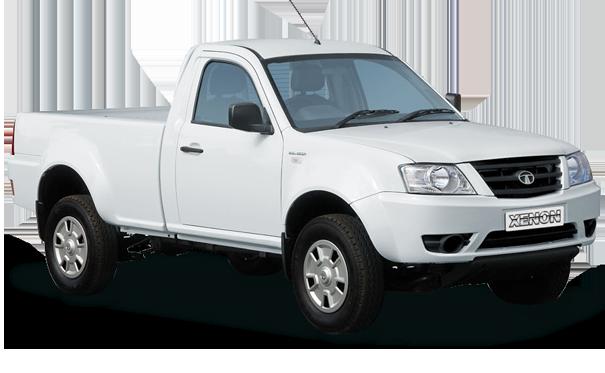
Tata Xenon Fleetline
When it comes to doing long distances with heavy loads, South Africa has two kinds of bakkie drivers, those in a Hilux — and those in “other bakkies”.
The good news is that even a Hilux can be had for less than R180 000 at reputable auctions this close to financial year-ends.
If the badge is not a problem, budget bakkie seekers will do very well to go kick the tyres of a Tata Xenon Fleetline. Then hang around the dealers’ waiting room for a while. Not all Tata dealers give equal after-sales service, and unsatisfied customers will soon reveal all in the waiting room.
Go lesser-spotted for best prices
Mahindra's Bolero
South Africa offers a slew of lesser-spotted bakkies and vans costing well below the R180 000 budget. They range in size from tiny Chinese to proven Koreans.
These days, the only potential drawback of buying a very affordable bakkie or van is that dealers may be few and far between on long-delivery routes. But for doing business in town, the low price of the lesser-spotted Chinese bakkies make them very attractive for even the most hardened Hilux fan.
The Tata Xenon offers the most Newtons for the least money, but by all accounts, Mahindra, Foton and JMC dealers are trying harder to keep their customers pleased.
Vans make more cents
If the load can easily be stolen, we advise a panel van. For delivering in and around town, the Chinese mini vans are a bit cramped for bigger drivers and will baulk at heavy pay loads, but for light, bulky loads, they offer fantastic value.
The DFSK mini van, going for less than R100 000, runs on an oil rag and has a good record in China.
For longer deliveries, either the Kia 2,7D Workhorse or Hyundai H100 Bakkie have long earned the respect of all fleet managers. Both sell for just over R170 000 and offer a very comfortable seating position.

South Africa's top 15 most affordable bakkies and vans
DFSK single cab mini bakkie R79 990
DFSK mini van R99 990
Foton 1-ton bakkie R122 950
Tata 3L Worker R123 995
Chevrolet Utility Club R124 100
Mahindra Bolero R129 900
Tata Xenon Fleetline R136 995
JMC Boarding R139 880
GWM Workhorse R139 900
Daihatsu Gran Max R139 995
FAW Sirius R150 000
Renault Kangoo Express R169 900
Isuzu KB200 R170 200
Kia Workhorse R171 995
Hyundai H100 Bakkie R173 900
For heavy loads, pick from this list:
Tata Xenon Fleetline 300 Nm
Mahindra Bolero 238 Nm
JMC Boarding 235 Nm
Foton 193 Nm
Tata 3L Worker 180 Nm

Rabu, 27 Februari 2013

Sucking the public purse dry via fuel taxes

This 18-month old Cambodian boy taught himself how to
suckle from a cow after the calf had done drinking.
Governments the world over do the same with petrol price,
except the State would try cramming all the teats into one mouth.
Having predicted that South Africa's fuel price will hover over R12/liter for the most part of 2013 in this blog, the latest budget speech by Finance minister Pravin Gordhan has taken the first step towards making this prediction a pillaging reality.

As he did in 2012, the Road Accident Fund (REF) and Fuel levies increased again, this time by 23 cents per litre.
This year it is 0,08c a litre for the RAF and 0,15c a litre for the fuel levies. (In 2012, it was also 8c for the RAF but 20c for the levies.)
South Africans  buy some 970 million litres of petrol and 980 million litres of diesel over an average month like September.
This means the latest  ZAR77,600,000 million the latest 8 cent increase will add from next month just in petrol.
Mr Gordhan sternly said he hopes our government will spend wisely the taxes our Receicer so efficiently gather.
Nobody laughed, and he did not make any other jokes during his speech.
Currently, the fuel price is South Africa is comrpised in the following manner:

Fuel price %
Basic fuel price and state levy 53.1
Customs, Duties, RAF, Basic Tax 27.9
Wholesale 7
Retail 8.4
Transport 2.4
Delivery 1.2

Above looks like government takes only a quarter of the money, which looks good compared to the UK or France, but "delivery" equates to a state-owned parastatal, while all other sectors pay add valorum tax on every drop we burn in our ICE engines.
Which means our government is still stretching the petrol teat like a kettie, and pillaging the public's purse with a least R8 billion a month in the process.
Which every economist tells us, will drive up inflation.
Electric engines, anyone?

Jumat, 22 Februari 2013

One night in Bangkok makes hard bikes jingle


Designs included a military issue leaning trike, a fatboy,
the latest in designer-biker hotpants
and  all the bling you can fit.
The Bangkok Motorbike Festival. (BMF) is quite unlike any other motorcycle show on Earth. Held within one of the world’s largest shopping centers, the festival parks bikes and scooters among upmarket boutiques and cafes. Thailanders — most all but born on scooters — throng the displays.
Apart from the international brands like Honda, the show also displayed bikes from brands totally unknown in South Africa, like Can-Am Spyder, Victory, SYM, Stallions and Zero Engineering.
For this year's BMF, Honda Thailand challenged the country’s customisers to design something different for the Bangkok Motorbike Festival.